

If you've ever experienced persistent discomfort, muscle soreness, or joint pain, you may have wondered whether a TENS machine could help. But how does a TENS machine actually work, and what does the science say about its effectiveness?
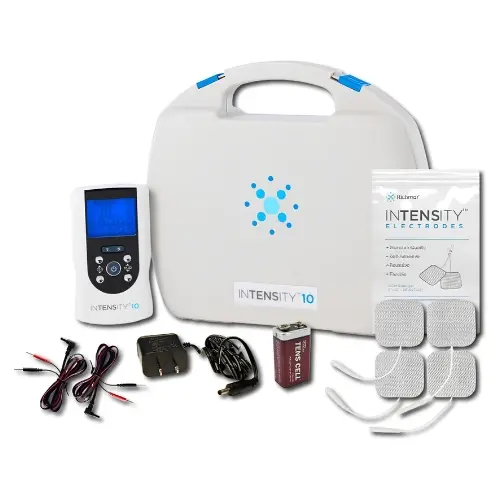
A TENS machine (Transcutaneous Electrical Nerve Stimulation) is a small, portable device that delivers controlled electrical impulses through adhesive electrode pads placed on the skin. These impulses stimulate nerves and influence how the nervous system processes pain, potentially providing temporary relief without medication or invasive procedures.
TENS therapy has been studied for decades and is used in physical therapy, rehabilitation, and at-home pain management. Research suggests that TENS can temporarily reduce pain intensity, although results vary depending on the individual, treatment settings, and type of pain.
In this guide, we'll explain the science behind TENS therapy, explore the research supporting its use, and discuss how to use this technology safely and effectively.
The Short Answer: How Does a TENS Machine Work?
A TENS machine works by delivering electrical pulses through the skin to stimulate peripheral nerves. These signals can activate pain-inhibiting pathways in the spinal cord and brain, reducing how strongly pain is experienced.
Researchers have identified two important mechanisms that contribute to TENS-related pain relief:
- Sensory nerve stimulation: Electrical impulses activate sensory nerves and spinal pathways that help regulate the transmission of pain-related information.
- Activation of the body's natural pain-inhibition systems: TENS can engage neural pathways involving endogenous opioids, chemicals the body naturally produces to help regulate pain.
These mechanisms may work together, rather than functioning as two completely separate processes.
Importantly, TENS does not repair damaged tissue or eliminate the underlying cause of pain. Its primary purpose is to help manage pain symptoms.
A Simple Way to Understand How TENS Works
Think about what happens when you bump your elbow or shin. Your natural reaction might be to rub the painful area.
Why?
Because touching or rubbing the skin activates sensory nerves that can influence how the nervous system processes pain.
TENS therapy uses a similar principle, but instead of relying on touch, it delivers controlled electrical pulses through electrodes placed on the skin.
These pulses activate sensory pathways that can help reduce the transmission and processing of pain-related signals.
The result: Your brain may perceive less pain while the stimulation is being applied.
For some individuals, relief may continue for a period after treatment. However, the duration and degree of relief are variable.
The Science Behind TENS Therapy: How Electrical Stimulation Reduces Pain
Understanding how TENS works requires looking at the nervous system.
When tissues are injured or irritated, specialized sensory nerve endings called nociceptors can respond to potentially harmful stimuli. Nerve signals travel toward the spinal cord, where they are processed and transmitted through pathways involved in pain perception.
The brain then interprets this information alongside other factors, including previous experiences, emotions, and signals from other sensory nerves.
TENS therapy influences this communication through several interacting neurological mechanisms.
Mechanism 1: Gate Control Theory of Pain
One of the foundational explanations for TENS therapy comes from the Gate Control Theory of Pain, introduced by researchers Ronald Melzack and Patrick Wall in 1965.
Their landmark publication, Pain Mechanisms: A New Theory, proposed that pain transmission is regulated by neural processes within the spinal cord.
Rather than pain signals traveling uninterrupted from an injured area directly to the brain, activity within the nervous system can increase or decrease the transmission of pain-related information.
This concept helps explain why stimulating certain sensory nerves may reduce the perception of pain.
How does this apply to TENS?
When a TENS machine delivers electrical impulses, it can activate large-diameter sensory nerve fibers, including A-beta fibers.
These fibers carry information associated with sensations such as touch and vibration.
Their activation can influence inhibitory circuits in the spinal cord, reducing the activity of some neurons responsible for transmitting pain-related information toward the brain.
This is often described as helping to "close the pain gate."
In practical terms, TENS can help reduce the intensity of pain that a person experiences, even though the underlying source of discomfort may still be present.
Mechanism 2: Activation of the Body's Natural Pain-Inhibition Systems
TENS therapy also influences chemical signaling systems involved in pain regulation.
The body produces natural substances called endogenous opioids, including endorphins and enkephalins, which interact with opioid receptors in the nervous system.
These substances play an important role in controlling pain.
Research suggests that electrical nerve stimulation can activate the body's natural opioid-mediated pain-inhibition pathways in the spinal cord and brain. A review by DeSantana et al. (2008), published in Current Rheumatology Reports, describes how TENS can influence these pathways, including the activation of different opioid receptor mechanisms depending on the stimulation frequency.
Experimental research has shown that:
- Lower-frequency TENS can activate mechanisms involving mu-opioid receptors.
- Higher-frequency TENS can activate mechanisms involving delta-opioid receptors.
This is an important distinction because the benefits of TENS cannot simply be divided into "high frequency blocks pain signals" and "low frequency releases endorphins."
Both higher- and lower-frequency stimulation can influence pain through multiple neurological mechanisms.
The relationship between frequency, stimulation intensity, individual physiology, and clinical effectiveness is complex.
Understanding TENS Machine Settings: Frequency, Intensity, and Pulse Width
Not all TENS treatments deliver electrical stimulation in the same way.
Most TENS units allow users or healthcare providers to adjust several settings that influence the sensation and pattern of stimulation.
Understanding these settings can help users recognize why one program may feel different from another.
1. Intensity: How Strong Is the Electrical Stimulation?
Intensity controls the strength of the electrical current delivered through the electrode pads.
With conventional TENS, the goal is generally to produce a strong but comfortable tingling sensation without pain.
Research suggests that adequate stimulation intensity is an important factor in achieving pain relief.
Setting the intensity too low may provide little noticeable benefit. Setting it too high can create discomfort or unwanted muscle contractions.
A useful principle is to adjust the device gradually until the stimulation feels clearly noticeable but remains comfortable, unless a healthcare provider or the device's instructions specify otherwise.
2. Frequency: How Often Are Electrical Pulses Delivered?
Frequency refers to the number of electrical pulses delivered per second, measured in hertz (Hz).
Two commonly discussed approaches include:
High-frequency TENS often uses approximately 50–150 Hz, depending on the device and clinical protocol.
It commonly produces a continuous tingling sensation and is frequently delivered at sensory-level intensity without a noticeable muscle contraction.
Low-frequency TENS often uses approximately 1–10 Hz.
It may be delivered at intensities that produce visible or palpable muscle twitches, depending on the protocol.
Lower-frequency stimulation has been associated with different opioid-mediated pain-inhibition mechanisms than higher-frequency stimulation.
Neither approach is automatically superior for every user.
3. Pulse Width: How Long Does Each Pulse Last?
Pulse width describes the duration of an individual electrical pulse, typically measured in microseconds (µs).
Pulse duration influences nerve recruitment and how stimulation feels.
Longer pulse widths may activate nerves at lower current amplitudes, while shorter pulse widths may require different intensity settings to achieve a similar sensation.
Pulse width, frequency, and intensity should be considered together rather than independently.
4. Treatment Modes: Continuous, Burst, and Modulation
Different TENS machines offer different stimulation patterns.
Continuous mode delivers pulses at a relatively consistent frequency.
Burst mode delivers groups of pulses at intervals.
Modulation mode automatically varies parameters such as frequency, pulse width, or intensity, depending on the device.
These options allow treatment to be adjusted for comfort and individual preferences.
However, research has not established that one stimulation mode consistently provides better pain relief for all conditions.
Many modern electrotherapy devices include preset programs that simplify these adjustments.
What Conditions Is TENS Therapy Commonly Used For?
TENS has been studied or used as a pain-management option for a wide variety of conditions.
Examples include:
Musculoskeletal and joint discomfort
TENS may be considered for pain associated with muscle soreness, joint discomfort, and certain musculoskeletal conditions.
Arthritis and osteoarthritis
Some individuals use TENS as an additional method for managing arthritis-related discomfort. However, condition-specific evidence is mixed, and it should not replace recommended exercise, rehabilitation, or medical treatments.
Back and neck pain
TENS is sometimes incorporated into rehabilitation programs for back or neck discomfort, although clinical recommendations vary and evidence for sustained benefits is inconsistent.
Neuropathic pain
TENS has been investigated for neuropathic pain, including some forms of nerve-related discomfort. Evidence remains uncertain for several neuropathic pain conditions, so treatment should be guided by a healthcare professional.
Menstrual and labor pain
TENS is also used for certain forms of menstrual discomfort and, under professional guidance, during labor.
Pain associated with injuries or recovery
Healthcare professionals may sometimes incorporate TENS into a broader pain-management or rehabilitation plan.
How Is TENS Different From EMS and Other Electrotherapy Treatments?
TENS is one of several types of electrical stimulation used in rehabilitation and pain management.
Although these technologies may look similar, their primary therapeutic goals differ.
TENS: Transcutaneous Electrical Nerve Stimulation
TENS is primarily used to help manage pain through electrical stimulation of peripheral nerves and pain-modulating pathways.
EMS and NMES: Electrical Muscle Stimulation
Electrical Muscle Stimulation (EMS), including Neuromuscular Electrical Stimulation (NMES), primarily targets motor nerves to produce muscle contractions.
In clinical rehabilitation, NMES may be used to support muscle re-education, strengthen weakened muscles in appropriate circumstances, and help address certain rehabilitation-related functional limitations.
Unlike conventional TENS, visible muscle contraction is commonly an intended part of NMES treatment.
Interferential Current Therapy (IFC)
Interferential therapy uses medium-frequency alternating currents to produce a lower-frequency amplitude-modulated stimulation pattern.
It is commonly used in clinical electrotherapy for pain management.
Although IFC is sometimes promoted as reaching deeper tissues more comfortably, claims that it consistently penetrates deeper or provides superior outcomes compared with TENS are not firmly established by clinical evidence.
Microcurrent Therapy
Microcurrent therapy uses extremely low-intensity electrical currents, often below the threshold of sensation.
It has been investigated for several clinical applications, including pain and tissue recovery, but evidence for particular therapeutic claims varies considerably.
It should not be assumed that microcurrent stimulation has the same established mechanisms or clinical outcomes as conventional TENS.
Understanding these differences can help patients and clinicians select equipment based on its intended application.
Learn more in our guide to choosing the right electrotherapy machine.
Is a TENS Machine Safe?
TENS therapy is generally well tolerated when used correctly and by appropriate users.
Because it does not involve medication, TENS avoids the systemic drug exposure associated with oral pain medicines.
However, being drug-free does not mean it is completely risk-free.
Potential adverse effects include skin irritation, discomfort from stimulation, and, in cases of improper use, skin injury or burns.
Who Should Avoid TENS or Seek Medical Guidance?
Do not use TENS without appropriate medical clearance if you have a pacemaker, implanted defibrillator, or other implanted electronic device that could be affected by electrical stimulation.
TENS should also be avoided or used only under appropriate professional supervision in situations involving:
- Epilepsy or a history of seizures
- Pregnancy, including intended use during labor
- Reduced sensation or numbness in the proposed treatment area
- Active cancer or a suspected tumor near the intended treatment area
- Unexplained or undiagnosed pain
- Other medical conditions for which the device labeling specifies precautions
Where Should TENS Electrode Pads Not Be Placed?
Unless specifically directed by a qualified healthcare professional using an appropriate device and protocol, avoid electrode placement:
- On the front or sides of the neck or over the throat
- Across the chest or in a configuration that sends current through the chest
- On the eyes, mouth, or head
- Over broken, infected, or significantly irritated skin
- On areas with reduced sensation
- In any location prohibited by the manufacturer's instructions
TENS should not be used while driving, operating machinery, bathing, showering, or sleeping.
If stimulation becomes painful, causes persistent irritation, or produces an unexpected reaction, stop using the device.
The NHS recommends consulting a healthcare professional before using TENS when there is uncertainty about its suitability.
This content is for general educational purposes only and is not a substitute for medical advice. Always follow your device manual and your healthcare provider's guidance.
Find the Right TENS Machine at TENSpros
At TENSpros, we believe choosing electrotherapy equipment should begin with understanding how the technology works, what the evidence supports, and which features are appropriate for the intended use.
Our selection includes TENS machines, electrotherapy devices, replacement electrode pads, and electrotherapy accessories for home users and healthcare professionals.
Whether you're exploring TENS therapy for the first time or selecting equipment for a clinical practice, understanding the science can help you make a more informed decision.
FAQs: How Does a TENS Machine Work?
Read our guide to TENS vs. EMS therapy.
Tagged Products



